
Baca County Dissolution Of Marriage Records
Baca County handles dissolution of marriage cases through the Combined Court in the 15th Judicial District located in Springfield. The court processes domestic relations matters for residents in Baca County and neighboring areas. You can request dissolution records through the clerk's office by phone, email, or in person. The court uses the same record request system as other Colorado courts, and you can access case information using online forms provided by the Colorado Judicial Branch. Most records are public, but some parts of dissolution cases may have restrictions under state law or court directives.
Baca County Quick Facts
Baca County Court Location
The Baca County Combined Court is part of the 15th Judicial District. This district serves Baca, Cheyenne, Kiowa, and Prowers counties in southeast Colorado. The courthouse in Springfield provides access to both District Court and County Court services. District Court handles dissolution of marriage cases along with felony criminal matters and larger civil cases. County Court deals with traffic, misdemeanors, and small claims.
For dissolution cases, you work with the District Court clerk. Springfield is a small community and the courthouse staff can answer your questions about filing procedures, fees, and what forms you need. Call ahead if you plan to visit so staff can prepare any files you want to review. The court page at coloradojudicial.gov/courts/trial-courts/baca-county has contact information and directions.
Rural counties like Baca have smaller court staffs but they provide the same services as larger counties. You get personal attention and staff who know the local procedures well. Many people find rural courts easier to navigate than busy urban courthouses.
The filing fee for a petition is $260 under C.R.S. § 13-32-101. If your spouse files a response, that costs $146. These fees are set by state law and apply in all counties. Fee waivers are available if you cannot afford to pay. Ask the clerk for a fee waiver form and instructions.
How To File For Dissolution
Filing in Baca County requires that one spouse meet the 91-day residency rule in C.R.S. § 14-10-106. This means at least one person must have lived in Colorado for 91 days before you file the petition. If you just moved to Baca County, wait until you have been here long enough to meet the requirement.
Colorado uses a no-fault standard for dissolution. The only ground you need is that the marriage is irretrievably broken. No one has to prove wrongdoing or assign blame. This rule is in the same statute that covers residency. It makes the process less hostile than fault-based divorce laws in some other states. You can file jointly or one spouse can file and serve the other with the petition.
When you file, an automatic injunction takes effect under C.R.S. § 14-10-107. This injunction stops both parties from selling property, moving children out of state, changing beneficiaries on insurance or retirement accounts, or taking other major financial actions without court permission or mutual agreement. It stays in place until the case ends. The goal is to preserve assets and maintain stability during the proceedings.
You can get forms from the clerk's office or download them from coloradojudicial.gov/self-help/divorce-and-separation. The site has instructions and standard forms for petitions, responses, financial affidavits, and parenting plans if you have children. Fill out the forms carefully and make sure all information is correct before you file.
Get Copies Of Dissolution Records
Baca County dissolution records are public documents in most situations. Exceptions include cases with confidential information, sealed records, or restricted files under court order. The general rule is that dissolution decrees and most case documents can be accessed by anyone who requests them. Parties to the case have broader access than the general public.
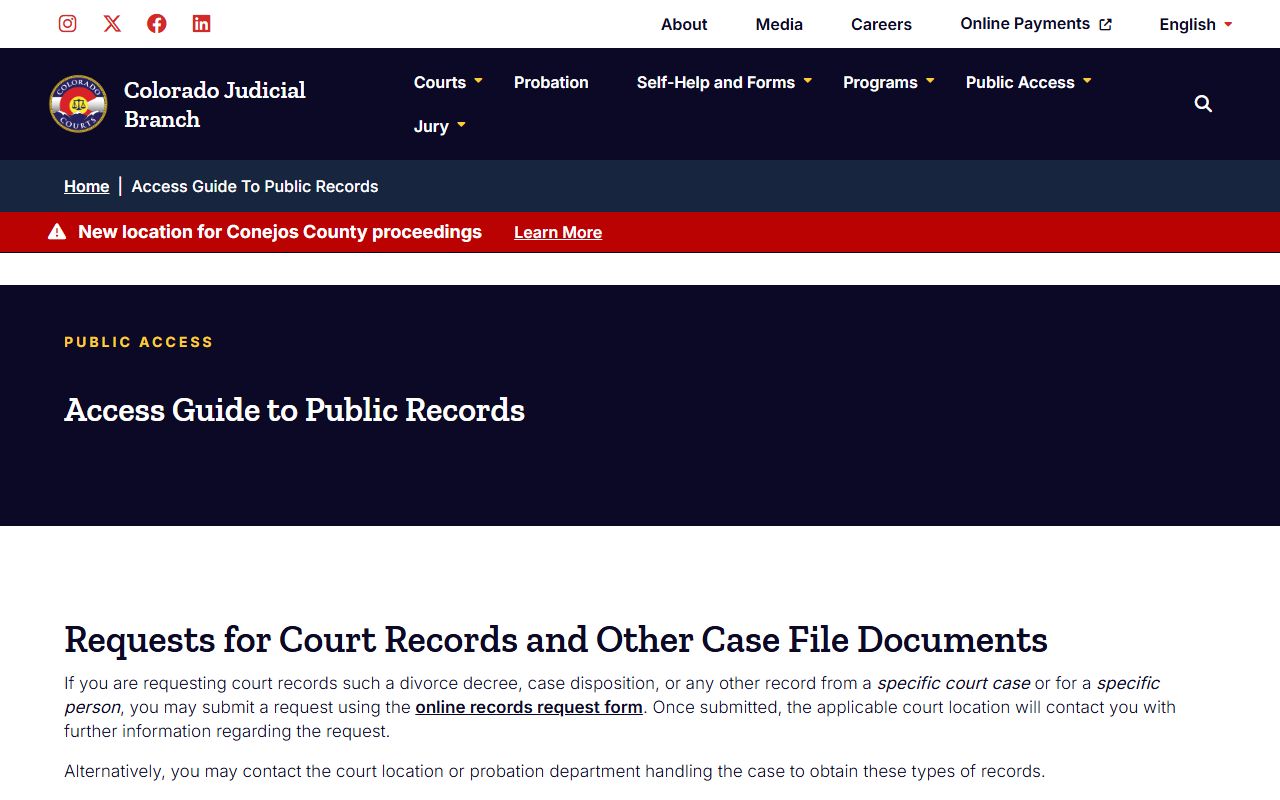
You can request records using the online form at coloradojudicial.gov/recorddocument-request-form. Provide the names of both parties, case number if you know it, and the type of record you need. The clerk will contact you about fees and how to get the records. Most requests are processed within three business days unless the file is stored off-site or needs special handling.
If you prefer, call or email the clerk's office directly. Email works well for simple requests where you know the case number. Phone calls work better if you have questions or need help finding a case. Staff can search by party name if you do not have the case number. They will tell you what records are available and how much it will cost to get copies.
Third-party vendors like CoCourts.com provide access to the register of actions for Colorado cases. These sites show case activity and filings but do not have the actual documents. You must request copies from the court to get decrees, orders, or other filed papers. The vendors charge fees for their services, separate from any court fees.
Fees For Records And Copies
Copy fees in Baca County follow the statewide schedule. Regular copies cost $0.25 per page. Double-sided pages are $0.50. If you are a party to the case, you pay a maximum of $15 for copies no matter how many pages you request. Non-parties pay per page without a cap.
Certified copies are $20 per document. These copies have an official stamp and signature from the clerk. Use certified copies if you need to prove the record is authentic to a bank, government agency, or other institution. Regular copies work fine if you just want the information for your own use and do not need to verify it with a third party.
If your case file is stored off-site, retrieval costs the actual expense. Research or redaction that takes more than one hour costs $30 per hour in 15-minute increments. Ask for an estimate before you request a large file or one that needs redaction of confidential information. This helps you budget for the total cost. Fee waivers for copies may be available under CJD 06-01 if you qualify based on income.
Dividing Property And Support Payments
Baca County courts use Colorado's equitable division standard from C.R.S. § 14-10-113. Equitable means fair, not necessarily equal. The court considers several factors when dividing marital property. These include the length of the marriage, each spouse's financial situation, contributions to the marriage, and economic circumstances of each party at the time of division.
Separate property stays with the person who owned it before marriage or received it as a gift or inheritance. Marital property includes assets and debts acquired during the marriage. The court identifies which property is separate and which is marital, then divides the marital property in a way that seems fair based on the facts of each case. If one spouse gave up career opportunities to care for children or support the other spouse's career, the court takes that into account.
Spousal maintenance may be awarded if one spouse needs financial support after dissolution. The rules are in C.R.S. § 14-10-114, which includes advisory guidelines for amount and duration. The guidelines are not mandatory but courts use them as a starting point. Factors include the length of the marriage, each spouse's income and earning ability, age and health, and the standard of living during the marriage. Maintenance can be temporary or long-term depending on the circumstances.
If you have children, the court will also address parental responsibilities and child support. Colorado uses income shares guidelines for child support. Both parents provide financial information and the court calculates support based on combined income and parenting time. The goal is to make sure children are supported adequately regardless of which parent they live with most of the time.
Legal Help And Resources
If you need legal help in Baca County, you have several options. Colorado Legal Services provides free assistance to low-income residents in civil matters including dissolution. You can apply for help through their website or by calling their intake line. Eligibility is based on income and household size. If you qualify, they can advise you on your case or represent you in court proceedings.
The court's self-help center offers forms and information for people who represent themselves. Staff cannot give legal advice but they can help you fill out forms correctly and explain court procedures. Many people handle their own dissolutions, especially if the case is uncontested and there are no complex property or custody issues. Self-representation works best when both parties cooperate and agree on terms.
Local attorneys in Springfield or nearby communities can represent you if you prefer to hire a lawyer. Private attorneys charge hourly rates or flat fees depending on the complexity of your case. Some offer payment plans or reduced fees for clients with limited income. Initial consultations are often free or low-cost, giving you a chance to discuss your situation and learn what legal representation would cost.
Nearby Counties
Baca County is located in the southeast corner of Colorado. It shares borders with Kansas and Oklahoma. Nearby Colorado counties include:
- Prowers County to the west
- Kiowa County to the north
All of these counties are part of the 15th Judicial District except for Bent and Otero. If you are not sure which county has jurisdiction over your case, file where you or your spouse currently resides or where your marriage took place.