
Douglas County Dissolution Of Marriage
Douglas County processes dissolution of marriage cases through the Combined Court in the 18th Judicial District located at the Douglas County Courthouse in Castle Rock. The court handles domestic relations matters including divorce, legal separation, and parental responsibilities for county residents. You can obtain records by submitting an online request through the state records request system, contacting the clerk's office directly, or searching through authorized third-party vendors that provide access to Colorado court docket information and case histories.
Douglas County Quick Facts
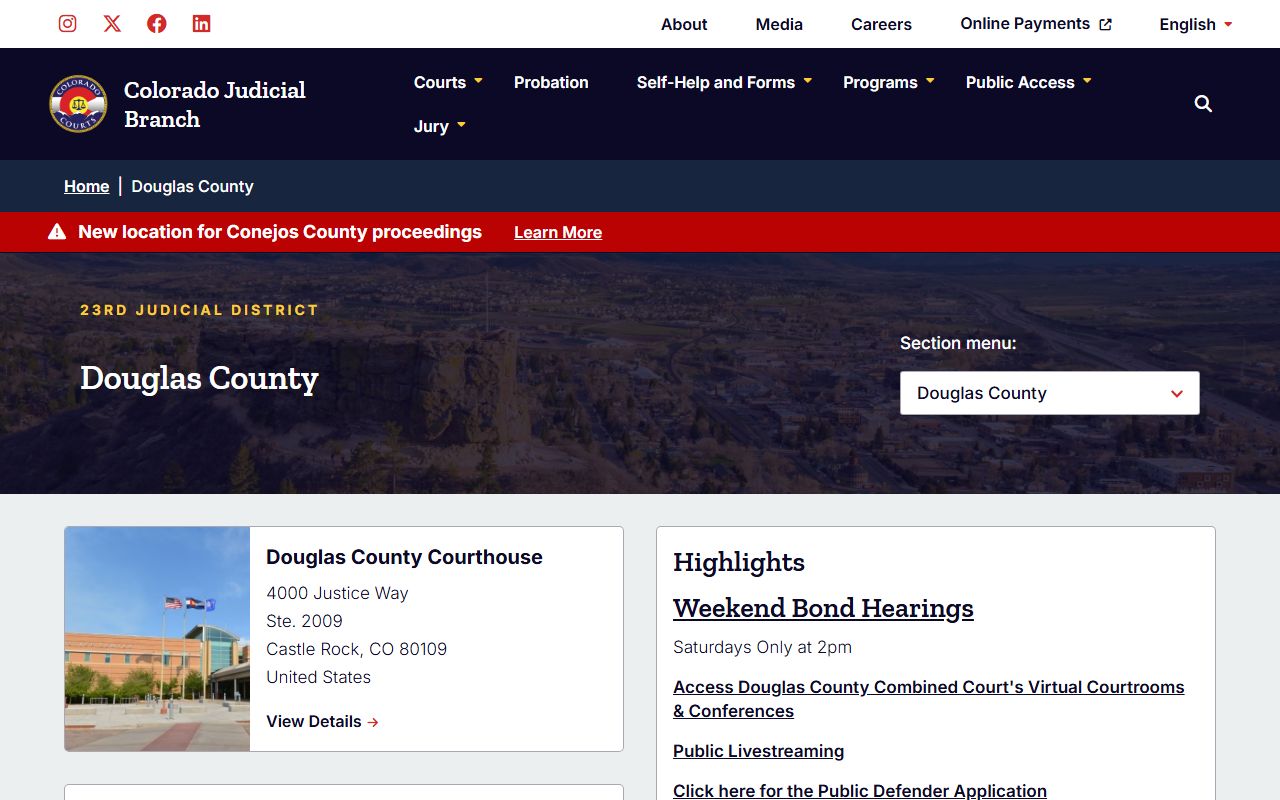
Douglas County Courthouse
The Douglas County Courthouse at 4000 Justice Way in Castle Rock serves as the main facility for the 18th Judicial District in Douglas County. This district also includes Arapahoe, Elbert, and Lincoln counties. The combined court handles district and county court matters. District Court processes dissolution of marriage cases, felony criminal cases, and larger civil matters. County Court deals with traffic offenses, misdemeanors, and small claims.
When you file for dissolution in Douglas County, you file with the District Court clerk. The filing fee is $260 for a petition under C.R.S. § 13-32-101. A response costs $146 if the other party files one. These fees apply statewide and were increased by the legislature in January 2025. If you cannot afford the fees, submit a fee waiver request. The court will review your financial information and decide if you qualify for a waiver or reduction.
Details about the court are available at coloradojudicial.gov/courts/trial-courts/douglas-county. The website lists contact information, courthouse hours, and links to local forms. Call the clerk's office if you have questions about filing or need help with procedures.
Staff at the courthouse can provide procedural guidance. They cannot give legal advice but can explain court rules and requirements. Many people file without a lawyer and staff can help you understand what forms you need.
File Dissolution In Douglas County
To file a petition for dissolution in Douglas County, one spouse must meet the 91-day residency requirement in C.R.S. § 14-10-106. This means at least one person must have lived in Colorado for 91 days before filing. The rule ensures the state has a real connection to the case and jurisdiction over the parties.
Colorado law uses a no-fault standard. The only ground for dissolution is that the marriage is irretrievably broken. You do not need to prove fault or wrongdoing. If one spouse says the marriage cannot be saved, that is enough for the court. The focus is on practical issues like dividing property, determining support, and making parenting plans if there are children.
Filing a petition triggers an automatic temporary injunction under C.R.S. § 14-10-107. This injunction applies to both spouses immediately. It prevents either party from selling property, taking children out of state, or changing insurance beneficiaries without court approval. The injunction stays in effect until the case ends or a judge modifies it. The purpose is to protect both parties and maintain stability during the case.
After you file, the other spouse must be served with the petition and summons. They have time to file a response if they choose. The court cannot enter a final decree until 91 days have passed since the respondent was served or filed their first document in the case. This waiting period allows both sides to negotiate and potentially settle issues. Many cases resolve through agreement rather than going to trial.
Access Douglas County Records
Douglas County dissolution records are generally public unless sealed by court order. You can request records through the online form at coloradojudicial.gov/recorddocument-request-form. Enter the case type, party names, and case number if you have it. The clerk's office will contact you with information about fees and how to get the documents.
Email requests also work. Send your request to 18records@judicial.state.co.us, which is the records email for the 18th Judicial District. Include full names of both parties, the case number if available, and what documents you need. Staff typically respond within three business days under normal circumstances. They will tell you what records exist and what it costs to get copies.
In-person requests are handled at the courthouse clerk's office in Castle Rock. Visit during business hours and ask staff to search for a case by name or case number. If you are a party to the case, bring a government-issued photo ID to access documents that may be restricted to parties and their attorneys.
Third-party vendors like CoCourts.com provide access to the register of actions for Douglas County cases. These databases show case activity and docket entries but do not provide copies of actual documents. For full case files or certified copies, you must contact the court directly. The vendors charge their own fees separate from court copy fees.
Fees For Document Copies
Douglas County follows the statewide fee schedule for copies. Regular copies are $0.25 per page for single-sided and $0.50 for double-sided. If you are a party to the case, the maximum fee for copies is $15 no matter how many pages. Non-parties pay per page without a cap.
Certified copies cost $20 per document. A certified copy includes the clerk's seal and signature to verify it is a true copy of the court record. You need certified copies when submitting documents to government agencies, banks, or other institutions that require proof of authenticity. Regular copies work fine if you just need the information for your own use.
Additional fees may apply for complicated requests. If the court must retrieve a file from off-site storage, you pay the actual cost of retrieval. If the request takes more than one hour of staff time for research or redaction, the court charges $30 per hour in 15-minute increments. Ask the clerk for an estimate if your request seems complicated so you know what to expect.
Property Division And Maintenance
Douglas County courts divide property according to C.R.S. § 14-10-113. Colorado uses equitable division, which means fair but not always equal. The court considers length of marriage, contributions of each spouse, economic circumstances, and the value of separate property. If one spouse stayed home with children while the other worked, the court takes that into account when dividing assets.
Separate property is not divided. This includes property owned before marriage or received as a gift or inheritance. Marital property includes most things acquired during the marriage. The court divides marital property based on what seems fair given the circumstances of your case.
Spousal maintenance may be awarded if one spouse needs financial support after dissolution. The rules are in C.R.S. § 14-10-114. The statute includes advisory guidelines that help judges calculate the amount and duration of maintenance payments. The guidelines are not mandatory but serve as a starting point. The final decision depends on the income of both spouses, length of marriage, and financial needs of each party.
Cities In Douglas County
Douglas County includes several cities with significant populations. Residents file dissolution cases with the Douglas County District Court in Castle Rock. The following cities in Douglas County have additional information:
Nearby Counties
Douglas County borders several other counties. If you are not sure which county to file in, file where you or your spouse lives. Adjacent counties include: