
Montezuma County Divorce Records Access
Dissolution of marriage cases in Montezuma County are handled through the Combined Court in the 22nd Judicial District. The court processes all domestic relations matters including divorce, legal separation, and allocation of parental responsibilities for county residents. You can access case records by submitting a records request to the clerk's office, using the statewide online record request form, or searching through third-party vendors authorized by the Colorado Judicial Branch to provide real-time court data access to the public.
Montezuma County Quick Facts
Montezuma County Court System
The 22nd Judicial District serves Montezuma County. The county seat is Cortez, where court business for dissolution of marriage cases takes place. District Court handles dissolution of marriage filings, property division disputes, and parental responsibility matters. All domestic relations cases go through the District Court clerk's office in Cortez.
The filing fee for a petition is $260 as set by C.R.S. § 13-32-101. A response costs $146. These fees changed in January 2025 when the state legislature updated the court fee schedule statewide. Fee waivers are available if you cannot afford the cost, but you must submit financial documentation showing income and expenses to qualify.
For information about court operations and contact details, visit https://www.coloradojudicial.gov/courts/trial-courts/montezuma-county. The site lists clerk's office hours, courthouse locations, and links to forms needed for filing. Check for updates on closures and any changes to how the court operates.
Clerk's office staff can answer procedural questions. They cannot give legal advice, but they can explain filing steps and tell you what forms are needed. If you are representing yourself without a lawyer, ask about self-help resources available through the court or local legal aid groups.
Filing For Dissolution In Montezuma County
To file for dissolution in Montezuma County, at least one spouse must meet the residency requirement. One party needs to have lived in Colorado for 91 days before filing the petition. This requirement comes from C.R.S. § 14-10-106, the statute governing dissolution proceedings in Colorado.
The state uses a no-fault system. Neither party has to prove wrongdoing or fault. The only ground for dissolution is that the marriage is irretrievably broken. This standard simplifies the legal process and avoids contentious blame-based arguments. Courts do not investigate who caused the breakdown. They focus on dividing assets, arranging custody, and resolving financial matters.
When you file, an automatic temporary injunction takes effect under C.R.S. § 14-10-107. This injunction stops both spouses from selling property, taking children out of state, or changing insurance beneficiaries without court approval or mutual agreement. The injunction protects both parties while the case moves forward. It stays in place until the case ends with a decree or settlement.
After you file the petition, the court needs 91 days to finalize the case. This waiting period applies even if both spouses agree on all terms. The 91 days start from when the court gains jurisdiction over the respondent. You cannot rush this timeline. It is built into Colorado law to give both sides time to work through issues and make informed decisions about property and parenting.
Bring your completed forms and the filing fee to the clerk's office or file electronically if the court offers e-filing for self-represented parties. If you qualify for a fee waiver, submit the waiver request along with your petition. The court reviews your income and expenses to determine if you meet the criteria. Fee waiver procedures are outlined in CJD 06-01, which sets the statewide policy for waiving court costs.
Accessing Dissolution Records
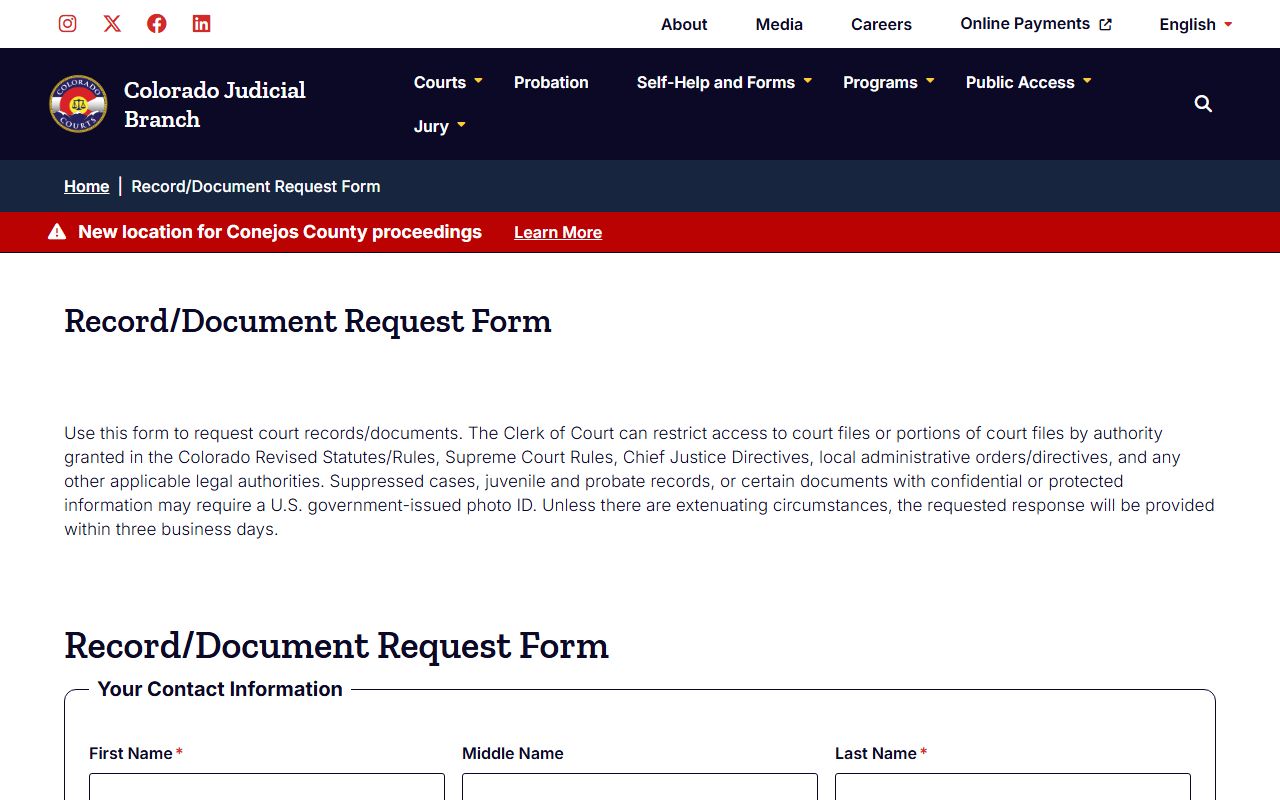
Most dissolution of marriage records in Montezuma County are public. You can request them through the online form at coloradojudicial.gov/recorddocument-request-form. Fill out the form with the case type, names of both parties, and the case number if you have it. Court staff will respond within three business days with instructions on how to get the records and the cost.
Email requests also work. Send your request to the court's records office with full names of both parties, an approximate filing or decree date, and the case number if known. Staff will search for the case and let you know what records are available. If the file is stored off-site or requires special handling, it may take longer than the standard three-day response time.
You can visit the clerk's office in person to request records. Bring any information you have about the case. Staff can search by name or case number. In-person visits allow you to ask questions and get immediate answers about what documents exist. If you are a party to the case and need access to restricted information, bring a government-issued photo ID to verify your identity.
Third-party vendors like CoCourts.com offer searches of Colorado court records. These services provide the register of actions, which is a summary of case activity. They do not provide copies of actual documents. To obtain certified copies or complete case files, you must contact the court. Third-party vendors charge their own subscription or search fees in addition to any court fees.
Public access to records is governed by CJD 05-01, the Chief Justice Directive on court records access. Some information is restricted or confidential, like financial data involving children, sealed documents, or records with privacy protections. If your request involves restricted material, the court may require proof that you are a party to the case or have legal authority to access the records.
Record Copy Fees
Montezuma County follows the statewide fee schedule for copies. Regular copies cost $0.25 per page for single-sided sheets. Double-sided pages cost $0.50. If you are a party to the case, you pay a maximum of $15 for copies no matter how many pages you need. This cap does not apply if you are not a party. Non-parties pay the per-page rate with no limit.
Certified copies cost $20 per document. A certified copy includes a clerk's signature and seal verifying it is an official record. You need certified copies for legal purposes such as submitting to government agencies, banks, or other institutions. Regular copies are suitable for personal use when you do not need to prove the document is an official court record.
If the file is stored off-site, there may be an additional retrieval fee. The cost is the actual expense to get the file from storage. Research or redaction that takes more than one hour costs $30 per hour, billed in 15-minute increments. Ask the clerk for an estimate before requesting a large or complex file so you know the total cost upfront.
Division Of Property In Montezuma County
Courts in Montezuma County follow Colorado law for dividing marital property. The state uses an equitable division standard set in C.R.S. § 14-10-113. Equitable means fair, not necessarily equal. The court considers the length of the marriage, each spouse's income and assets, contributions to marital property, and economic circumstances when deciding how to divide assets.
Separate property stays with the spouse who owned it. This includes property owned before the marriage or received as a gift or inheritance during the marriage. Marital property is anything acquired during the marriage. The court divides marital property based on fairness. If one spouse contributed more financially while the other managed the household, both contributions count. The court aims for an outcome that reflects each party's role and needs.
Retirement accounts, real estate, vehicles, and personal property are all subject to division. The court may order one spouse to buy out the other's share of an asset, or it may order the sale of property with proceeds divided. If spouses agree on how to split property, the court usually approves the agreement as long as it is fair and entered voluntarily. Agreements must be in writing and submitted to the court for approval.
Note: Property acquired after separation may be considered separate if you can show it was not part of the marital estate.
Spousal Maintenance Rules
Spousal maintenance, sometimes called alimony, may be awarded when one spouse needs financial support after dissolution. Colorado law on maintenance is in C.R.S. § 14-10-114. The statute provides advisory guidelines to help courts determine how much maintenance to award and for how long.
The guidelines are based on the length of the marriage and the combined adjusted gross income of both spouses. Shorter marriages typically result in shorter maintenance periods. Longer marriages may result in longer support terms. The guidelines are not mandatory. Judges can adjust the amount or duration based on factors like age, health, earning capacity, and financial resources of each party.
Maintenance can be temporary or permanent. Temporary maintenance lasts for a set number of months or years. Permanent maintenance continues until the recipient remarries or either party dies. Courts rarely award permanent maintenance unless the marriage was very long or the recipient has significant health or age-related barriers to self-support.
If circumstances change, either party can ask the court to modify maintenance. A significant change in income, employment status, or health can justify a modification. The party seeking the change must file a motion and prove the change in circumstances. Modifications are not automatic. The court must approve any changes to the original order.
Self-Help Resources For Montezuma County
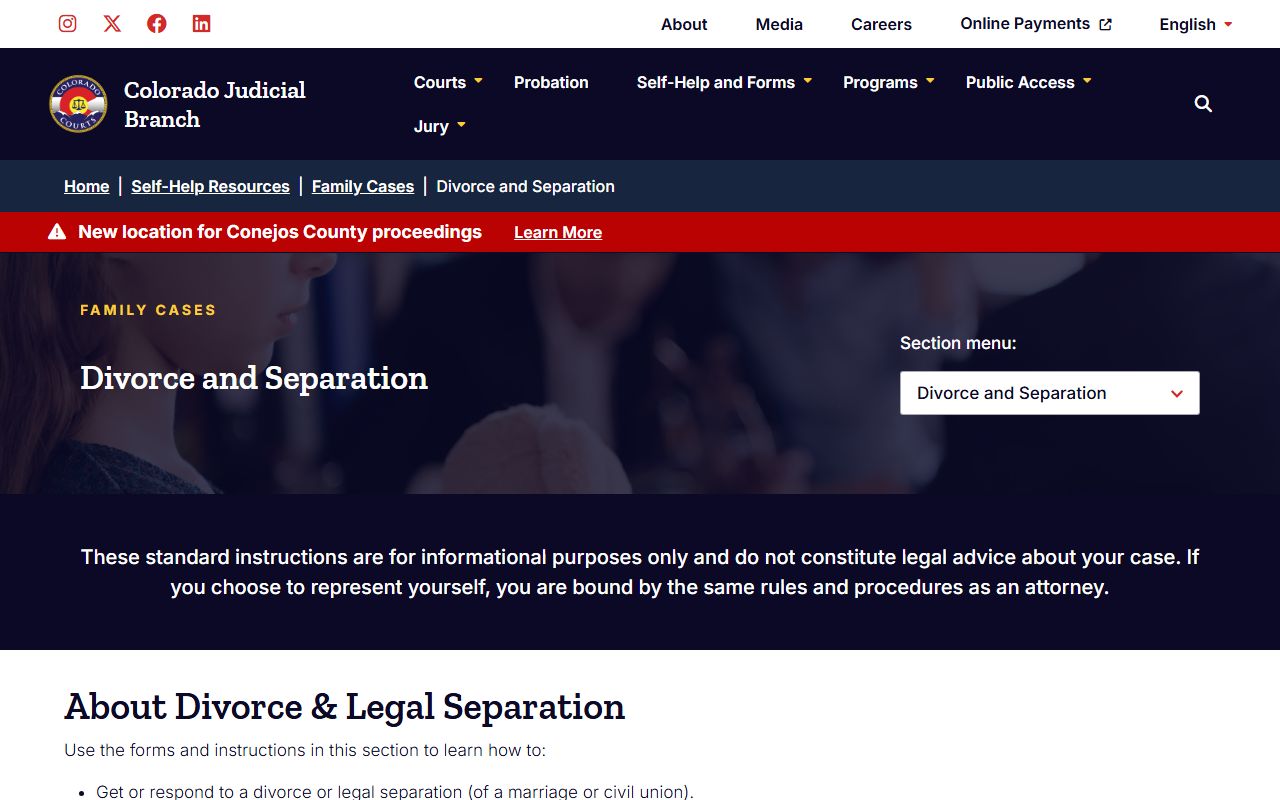
Colorado provides self-help resources for people filing for dissolution without a lawyer. The state Judicial Branch website has forms and instructions at coloradojudicial.gov/self-help/divorce-and-separation. The site covers how to file a petition, how to respond if your spouse files, and how to request a decree without a court hearing in uncontested cases.
You can download forms for free. The forms use a JDF numbering system. Common forms include JDF 1011 for the petition, JDF 1015 for the response, and JDF 1018 for requesting a decree without appearance. Instructions explain how to fill out each form and what to do next. Read the instructions carefully before you submit anything to the court.
If you need help with forms, check if the court has a self-help center or family court facilitator. Some courts offer assistance with filling out paperwork and understanding procedures. Staff cannot give legal advice or tell you what to do in your case, but they can explain the process and point you to resources.
Legal aid organizations may help if you meet income guidelines. Look for local nonprofit legal services that handle family law matters. Some offer free consultations or limited-scope representation where a lawyer helps with specific parts of your case. Contact Colorado Legal Services or local bar associations for referrals.
Public Access And Restrictions
Not all dissolution records are fully public. Chief Justice Directive 05-01 governs access to court records in Colorado. The directive balances public access with privacy protections. Most case information like party names, filing dates, and hearing schedules is public. Some documents are restricted or sealed.
Financial affidavits that include income and asset details may be restricted. Documents involving children, like parenting plans with addresses or school information, may have limited access. If a case involves domestic violence, the court may seal parts of the file to protect victims.
If you are a party to the case, you have broader access rights. You can request your full case file including restricted documents. Bring a government-issued photo ID when you request records in person. The clerk will verify your identity before releasing restricted material. Non-parties can only access public portions of the file unless they obtain a court order.