
Mesa County Dissolution Of Marriage Records
Dissolution of marriage cases in Mesa County go through the District Court in the 21st Judicial District located at the Mesa County Justice Center, 125 N. Spruce Street in Grand Junction. The court keeps all dissolution files and decrees for cases filed in the county. You can request records online, by mail, or in person at the clerk's office. Staff can help locate case files if you provide the names of both parties or have a case number. Most record requests are processed within a few business days.
Mesa County Quick Facts
Mesa County District Court
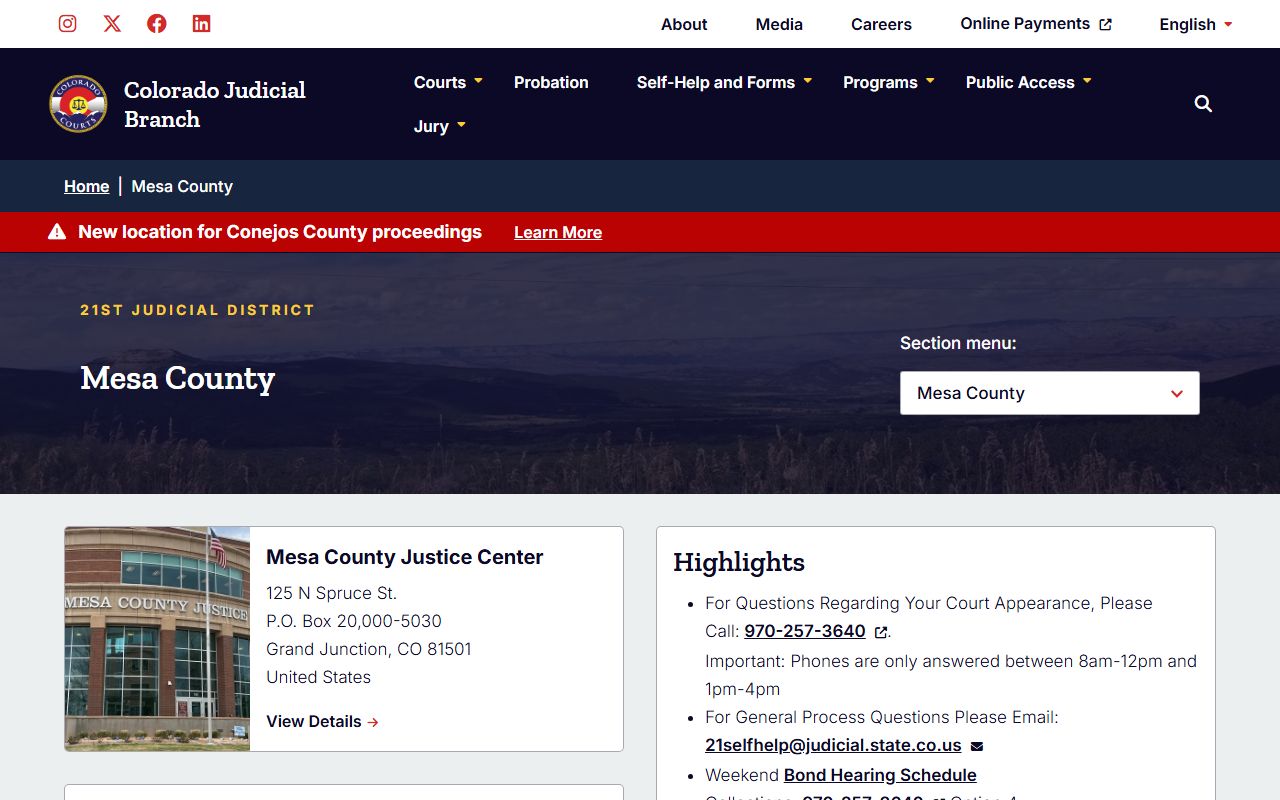
Mesa County is part of the 21st Judicial District. The District Court handles dissolution of marriage along with other domestic relations cases. The courthouse is at the Mesa County Justice Center, located at 125 N. Spruce Street in Grand Junction, CO 81501. This is the primary location for all court services in Mesa County.
The clerk's office can help with questions about filing new cases, getting copies of existing records, and understanding court procedures. If you need to find an old dissolution case or request a certified decree, the staff can search the system and tell you what is available. You can visit coloradojudicial.gov/courts/trial-courts/mesa-county for contact details, hours, and any notices about closures or schedule changes. The page includes links to local forms and resources for self-represented litigants handling their own dissolution cases.
Colorado law requires that one spouse be a resident of the state for at least 91 days before filing for dissolution. Cases filed in Mesa County follow the same procedures used across the state. The petition is filed, the other spouse is served, and both parties have time to work out terms or go to a hearing. Under C.R.S. § 14-10-106, the court must find that the marriage is irretrievably broken before granting a dissolution. There is also a mandatory 91-day waiting period after the respondent is served or files a response.
File For Dissolution In Mesa County
To file for dissolution in Mesa County, go to the clerk's office at the Mesa County Justice Center. The filing fee is $260, which is set by Colorado statute under C.R.S. § 13-32-101 and applies across all counties. If the other spouse files a response, that costs $146. If you cannot afford the fees, you can request a fee waiver by submitting financial documents that show your income and expenses. The judge decides if you qualify based on your financial situation.
When you file the petition, an automatic temporary injunction takes effect immediately. This is required by C.R.S. § 14-10-107. The injunction stops both spouses from hiding assets, selling property, or taking children out of state without court permission. It stays in place until the case is resolved or the judge modifies it. This protects both parties during the proceedings and prevents one spouse from gaining an unfair advantage.
After filing, you must serve the petition on the other spouse. They have time to respond to the allegations and requests in the petition. Colorado law requires a 91-day waiting period from the date of service or the date the respondent files a response. This wait cannot be shortened. During this time, spouses often negotiate agreements on property division, spousal support, and parenting if there are kids. If both parties agree on all issues, they may be able to get a decree without appearing at a hearing by using the affidavit process outlined in Colorado court rules.
Request Dissolution Records
Mesa County residents can request dissolution of marriage records in several ways. The online records request form is available at coloradojudicial.gov/recorddocument-request-form. Fill in the case type, both parties' names, and the case number if you have it. The clerk will review your request and contact you with the cost and payment instructions. Most requests are processed within three business days unless there are complications with the file.
For mail requests, write to the Mesa County Clerk at 125 N. Spruce Street, Grand Junction, CO 81501. Include the names of both spouses, the case number, and a description of what documents you need. Add a check or money order for the copy fees. The clerk will mail the copies back once the request is complete. If the file is stored off-site, it may take a few extra days to retrieve it.
You can also visit the courthouse in person. The clerk's office is open during regular business hours. Bring the case details with you. Staff can look up the case and tell you what records are available. If the file is on paper and not in the digital system, they will put in a request to have it retrieved. This can take a few days depending on where the file is stored.
Third-party services like CoCourts.com offer access to the register of actions for Mesa County cases. The register shows case filings, hearings, and basic info about what has happened in the case. It does not include the actual documents. To get copies of decrees, petitions, or settlement agreements, you still need to contact the court directly.
Fees For Copies And Documents
Copy fees in Mesa County follow the state schedule. Regular copies cost $0.25 per page for single-sided pages and $0.50 per page for double-sided pages. If you are a party to the case, the maximum fee is $15 no matter how many pages are in the file. Non-parties pay the per-page rate with no cap. Certified copies cost $20 per document. Certified copies include a seal and clerk's signature, which is required for legal uses like proving marital status or submitting to another court.
If your file is stored off-site or requires more than one hour of staff time to locate, research, or redact information, extra fees may apply. Off-site retrieval fees are based on the actual cost to bring the file to the courthouse. Research and redaction fees are $30 per hour, billed in 15-minute increments. Ask the clerk for a cost estimate before you pay so you know the total amount.
Fee waivers are available for parties who cannot afford the costs. You must file an affidavit showing your income, expenses, and assets. The judge reviews the affidavit and decides if you qualify for a full or partial waiver. Fee waivers apply to filing fees and some service costs, but may not cover all copy fees depending on the circumstances.
Dividing Property And Support
When Mesa County courts divide property in a dissolution case, they follow Colorado law under C.R.S. § 14-10-113. The court first sets apart each spouse's separate property. Separate property includes anything owned before the marriage, gifts or inheritances received by one spouse, and property excluded by a valid prenuptial agreement. The court then divides marital property equitably, which does not always mean equally.
Marital property is everything acquired during the marriage, including income, real estate, retirement accounts, and personal belongings. Even if an asset is in only one spouse's name, it may still be marital property if it was acquired during the marriage. The court looks at several factors when dividing marital property. These include the contribution of each spouse to the marriage, the value of separate property each spouse has, and the economic circumstances each will face after the dissolution. The goal is a fair division based on the specific facts of the case.
Spousal maintenance may be awarded if one spouse needs financial support after the dissolution. Colorado has advisory guidelines under C.R.S. § 14-10-114 that help calculate the amount and duration of maintenance based on the length of the marriage and the combined income of both spouses. Maintenance is not automatic. The court considers whether the spouse seeking support can meet reasonable needs from other sources and whether the paying spouse has the ability to pay. Spouses can agree to a different amount or term if they both consent and the court approves the agreement.
Resources For Dissolution Cases
The Colorado Judicial Branch website has self-help resources for people handling dissolution cases without a lawyer. The divorce and separation page at coloradojudicial.gov/self-help/divorce-and-separation includes forms for filing a petition, responding to one, and requesting a decree without a hearing. Many Mesa County residents use these forms and instructions to complete their own cases, especially when there are no children or major property disputes.
If you need legal advice, consider consulting a family law attorney in Mesa County. Attorneys can explain your rights, help you prepare documents, and represent you in court if needed. Some offer free or low-cost consultations. Legal aid organizations may also assist if you meet income guidelines.
You can view the full list of court fees at coloradojudicial.gov/self-help/list-fees. This page shows filing fees for petitions, responses, motions to modify, and other family law filings. Knowing the fees in advance helps you plan for the costs of the case.
Cities In Mesa County
The city of Grand Junction is the largest city in Mesa County and the county seat, with over 65,000 residents. Dissolution of marriage cases for Grand Junction residents are filed at the Mesa County Justice Center, which is located in the city. Other communities in Mesa County also use the same courthouse for domestic relations cases.
Nearby Counties
If you need dissolution records from counties near Mesa, check these pages:
Each county maintains its own dissolution records. You must contact the county where the case was filed to get copies.
Note: The State Archives has historical divorce records for some counties, but most modern dissolution cases are maintained by the District Court in the county where they were filed.