Garfield County Dissolution Of Marriage
Garfield County processes dissolution of marriage cases through the 9th Judicial District Combined Court in Glenwood Springs. All divorce filings for the county go through this courthouse. The clerk's office maintains all case files and records for dissolution proceedings. If you're filing a new petition or searching for existing records, this is where you need to go. Colorado law requires one spouse to be a state resident for at least 91 days before you can file. This requirement is in C.R.S. § 14-10-106. After you file, the court must wait another 91 days before issuing a final decree. This waiting time lets both parties work through property division, custody arrangements, and support obligations.
Court Details
County Seat: Glenwood Springs
Judicial District: 9th
Population: ~61,000
Starting A Case
The filing fee for a dissolution of marriage petition is $260 under C.R.S. § 13-32-101. This amount is set by state law and applies in all Colorado counties. Forms are available at https://www.coloradojudicial.gov/self-help/divorce-and-separation. The main form is JDF 1011, Petition for Dissolution of Marriage. Download it for free, fill it out, and file it at the Garfield County clerk's office.
When you file the petition, the clerk assigns a case number. Save this number. You'll need it for all future filings and record requests. After filing, you must serve the petition on your spouse. You can't do this yourself. Use a process server, the sheriff's department, or have the clerk mail it. Service proves the other party was notified of the case.
Colorado uses no-fault divorce, so you only state the marriage is irretrievably broken. No need to prove wrongdoing. Automatic injunctions take effect when you file under C.R.S. § 14-10-107. These orders stop both spouses from selling property, hiding assets, or taking children out of state.
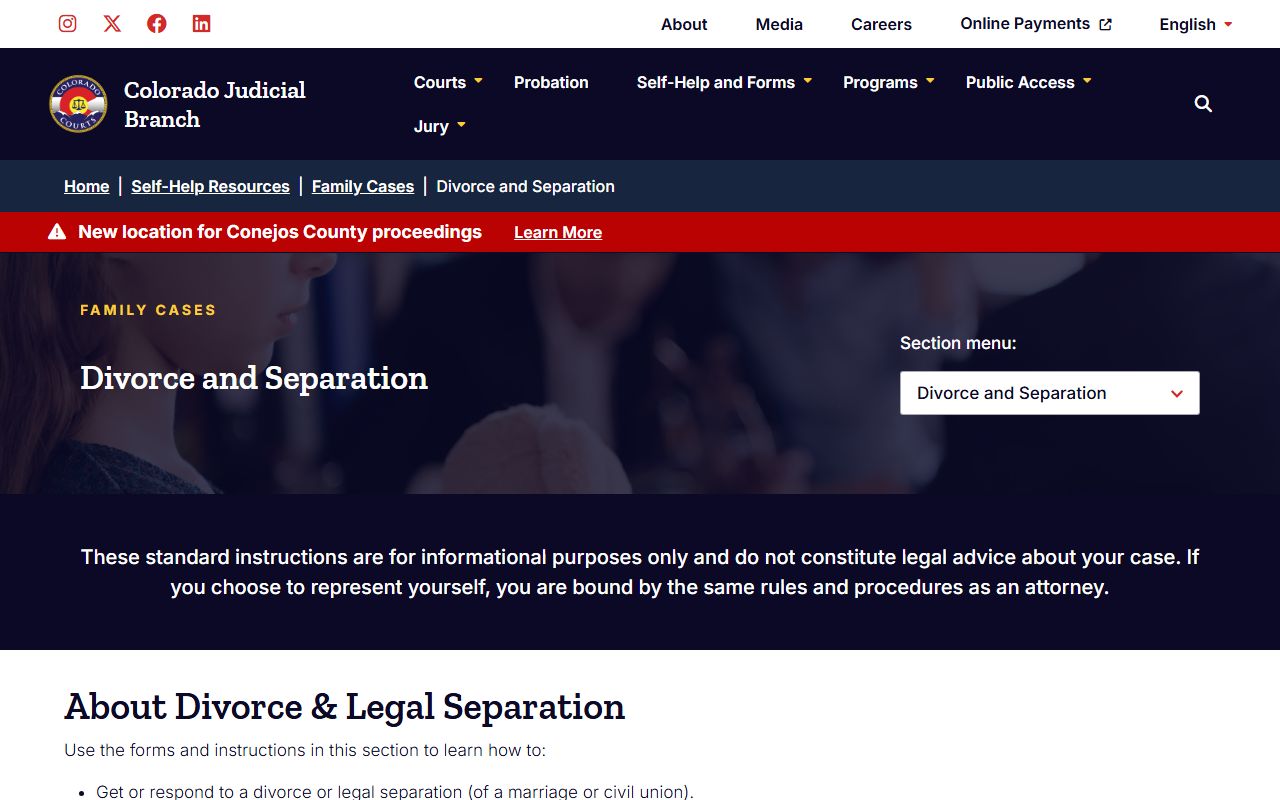
The self-help divorce page provides forms and instructions for Garfield County dissolution of marriage cases.
Property Division Rules
Property division is a major part of any dissolution. Colorado requires fair division, which doesn't mean equal. The court uses C.R.S. § 14-10-113 to guide decisions. Judges look at marriage length, each spouse's contributions, financial situations, and asset values.
Marital property is what you got during the marriage. Wages, homes, cars, and bank accounts fall into this category. Separate property is what you owned before or got as a gift or inheritance. Normally, separate property stays with its owner. But if you mix separate property with marital property, it can become marital. This mixing is called commingling. If you deposit inherited cash into a joint account, it might become marital property.
Real estate, vehicles, retirement accounts, and businesses all get divided. Retirement benefits earned during marriage are marital assets. Courts can split them with a qualified domestic relations order. PERA plans use form JDF 1202. Debts also get split. Credit cards, mortgages, and loans from the marriage are shared unless one person took on debt for personal reasons after you separated. Courts try to balance everything so both parties end up in similar financial spots.
Spousal Maintenance
Spousal maintenance, or alimony, may be ordered. Colorado uses advisory guidelines in C.R.S. § 14-10-114. These apply to cases filed after January 1, 2014. The guidelines provide a formula based on combined income and marriage duration. Courts can follow or adjust them for special circumstances.
Maintenance isn't automatic. The person requesting it must prove need. The other person must have the ability to pay. Judges consider age, health, job skills, and the lifestyle you had during marriage. Short marriages rarely result in long-term maintenance. Longer marriages often mean longer support terms. Maintenance can be temporary or permanent. Temporary lasts during the case and ends at the decree. Permanent continues after, usually for a set time.
Either party can request a change if circumstances shift. Job loss, illness, or remarriage can trigger modification. File a motion and show the court what changed.
Getting Records
Dissolution of marriage records are public, though some parts may be sealed. The final decree is usually open. Files with custody details, parenting plans, or financial data may be restricted. Chief Justice Directive 05-01 governs access.
Request records online at https://www.coloradojudicial.gov/recorddocument-request-form. Enter the case number and party names. Courts typically respond in three business days. Without a case number, clerks can search by name for $5.
Visit the clerk in Glenwood Springs to view files in person. If you're a party, bring photo ID. The clerk pulls the file. Viewing is usually free. Copies cost $0.25 per page for parties, with a $15 maximum. Certified copies are $20 each. You need certified copies for legal purposes like Social Security or remarriage.
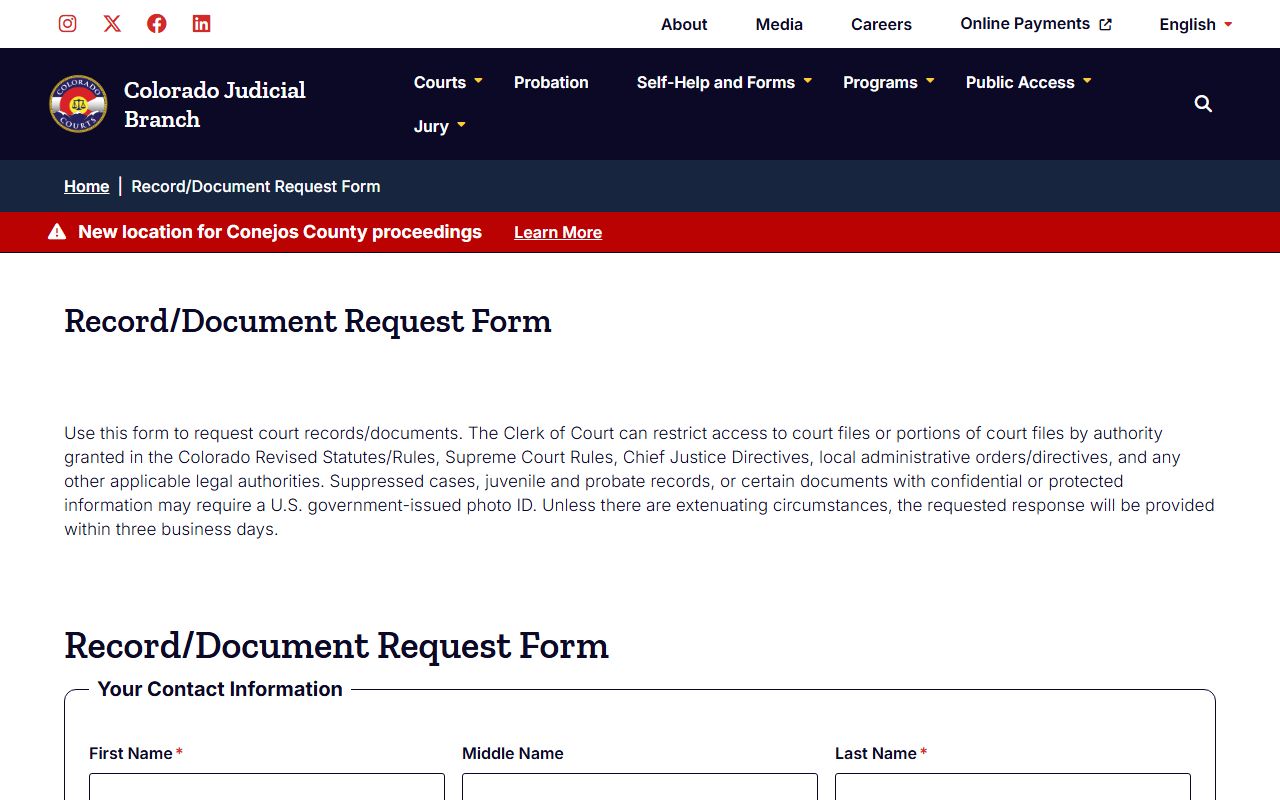
Use the online records request form to get Garfield County dissolution of marriage documents.
Fee Waivers
Can't afford the $260 filing fee? You may qualify for a waiver. Colorado law allows waivers for low-income filers under C.R.S. § 13-32-104. File a Motion to File Without Payment. Include proof of income like pay stubs or benefit letters. The court reviews your finances and decides.
A waiver covers filing fees and may cover service and copy costs. It doesn't pay for lawyers. If approved, you can proceed without upfront payment. This helps people who need legal relief but lack funds.
Self-Help Resources
Many Garfield County residents handle dissolution without attorneys. Colorado provides free resources. The self-help section has step-by-step guides. It explains how to fill out forms, file them, and serve them. Instructions use plain language.
Forms include the petition, response, separation agreement, and parenting plan. If you and your spouse agree on everything and have no kids, use the simplified process. Form JDF 1018, Affidavit for Decree Without Appearance, lets the judge sign your decree without a hearing. This saves time and court trips.
Need help with forms? Contact the clerk's office. Clerks answer procedural questions but can't give legal advice. For legal guidance, try Colorado Legal Services or a local legal aid office. Some areas have family law facilitators who help with forms for free or low cost.
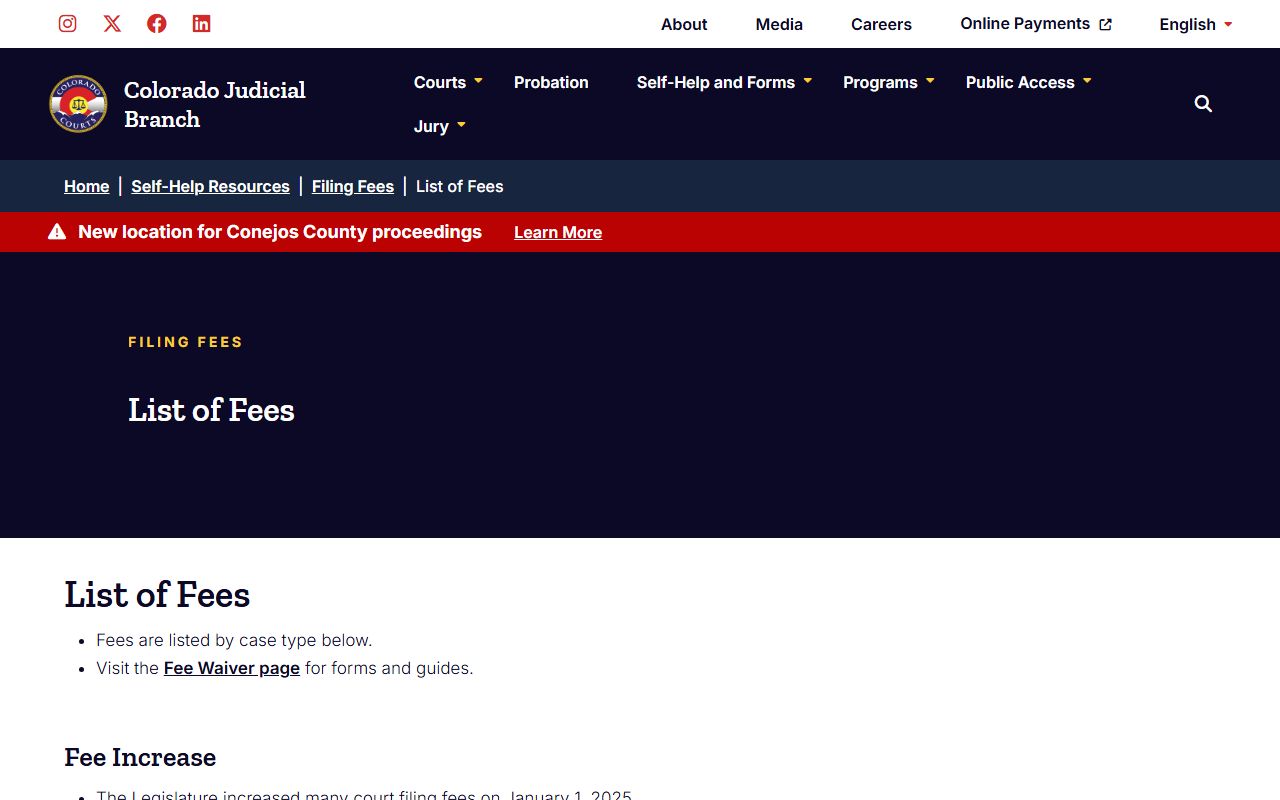
The complete fee schedule lists all court costs for dissolution of marriage cases.
Name Restoration
Changed your last name when you married? You can restore your former name in the dissolution decree. Include the request in your petition or response using form JDF 1011 or JDF 1015. The judge adds it to the final decree. If you decide later, file form JDF 1824, Motion for Name Restoration. No fee if you file within 60 days of the decree. After that, standard fees apply.
Once approved, use certified copies to update your Social Security card, driver's license, bank accounts, and other records. Get several certified copies from the clerk's office.
Court Location
The 9th Judicial District court for Garfield County is in Glenwood Springs. Visit https://www.coloradojudicial.gov/courts/trial-courts/garfield-county for the address, phone, and hours. Courts typically open Monday through Friday during business hours. Some offices close for lunch. Call ahead to confirm.
For general Colorado court questions, call the state court administrator at 720-625-5000. Email public.access@judicial.state.co.us. For case-specific questions, contact the Garfield County clerk directly.
Third-Party Searches
Besides official records, you can use commercial databases. CoCourts.com is a third-party site approved by the Colorado Judicial Branch. It provides the Register of Actions for civil, domestic, and criminal cases. The Register shows filings, hearings, and outcomes, but not full documents. For documents, request them from the court.
CoCourts.com charges a fee. It covers Garfield County and most Colorado counties. Data updates in real time. Remember, online databases may have errors. For official records, always verify with the court.
Nearby Counties
Garfield County is in the 9th Judicial District with Pitkin and Rio Blanco counties. Each county has its own clerk and files. Links to nearby county pages: